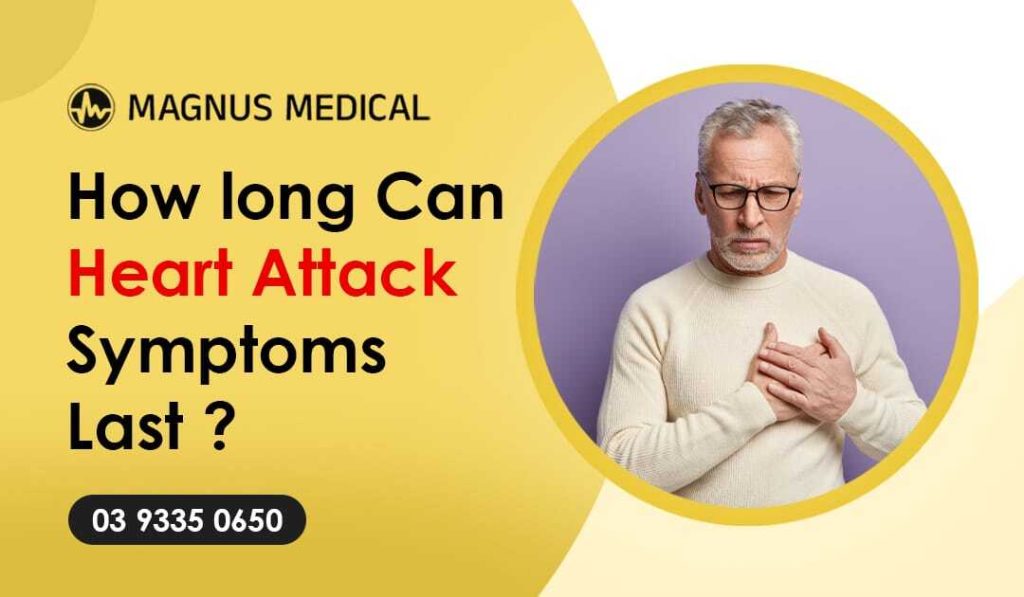
A heart attack can kill. You may be thinking: how long does a heart attack last? There is no general length of time; sometimes it only lasts for a few minutes, sometimes for a few hours, and sometimes for over 24 hours. Here, we look at what a heart attack actually entails, what to do about warning symptoms and what you can do in your daily life to avoid one from happening.
Table of content
A heart attack occurs as a sudden loss of blood supply to a section of the heart muscle. This is as a result of one or more of the blood vessels that supply blood to the heart with oxygen (the coronary arteries) becoming blocked. When an artery is blocked, your heart muscle doesn’t receive enough oxygen, which means it can’t provide blood to the rest of your body. A heart attack is also called a myocardial infarction. A heart muscle can be permanently damaged without enough oxygen.
If you suffer from a heart attack, there may be a range of symptoms that become noticeable. Signs and symptoms of a heart attack vary and are not identical in every person. You may be experiencing a heart attack if you are breathless, experience chest pain, or feel faint. Other typical signs and symptoms of a heart attack may be:
Coronary artery disease is the most common cause of a heart attack. This happens when the arteries of the heart get blocked by plaque. Plaque is made up of cholesterol, fat, and other substances. If the plaque bursts, it will lead to blood clot formation. This blocks the flow of blood and oxygen to your heart muscle, leading to damage. Other causes of a heart attack include:
Heart attack symptoms usually last anywhere from a few minutes to several hours. While some people experience intense, sudden pain, symptoms often start slowly as mild discomfort that builds gradually. The pain can be continuous, or it may stop or return later. The longer someone experiences heat attack symptoms, the more serious the damage can be. Again, this is why considering emergency medical treatment as soon as you suspect a heart attack is crucial. Sometimes people may confuse the symptoms of a heart attack with other causes of chest pain, like digestive issues, anxiety, or a panic attack. If you are just experiencing digestive issues or general muscle pain, you can get in touch with Glenroy GP at Magnus Medical.
Recovering from a heart attack also occurs at different rates: it might take a few weeks or several months before a person feels better enough to resume their usual routine, especially if they are a more active individual.
If you think you or someone else is having a heart attack, it’s important to call triple-zero (000) right away and ask for an ambulance. Early treatment is important to save a life.
An overdose of insulin can’t directly lead to a heart attack. However, an overdose of insulin can lead to hypoglycemia, which can increase the risk of a heart attack. The chance of this can be significantly higher for those with heart conditions.
To prevent a heart attack, you need to follow the steps given below:
There is no specific heart rate that defines a heart attack. If someone is having a heart attack, the heart rate can be low, high, or completely normal.
Conclusion
There can be many causes of a heart attack. If you notice heart attack symptoms, consult with a doctor as soon as possible. However, if you think it’s not a heart attack, but common digestive issues or general muscle pain, you can speak to doctors at Magnus Medical.
Other Useful link:
Pathology glenroy